media coverage
In the water treatment industry, reverse osmosis (RO) technology has become a core process for pure water production, seawater desalination, and advanced industrial wastewater treatment, thanks to its outstanding desalination and purification performance.However, the long-term stable operation of an RO system starts not with the membrane - but with the feed water quality. Among all water quality control parameters, theSilt Density Index (SDI) is widely recognized as a critical indicator for evaluating the fouling potential of colloids and suspended particles in feed water. The SDI value directly determines membrane lifespan, system energy consumption, and permeate water quality.
1. Core Definition and Diagnostic Value of SDI
The Silt Density Index (SDI) is a critical parameter used to evaluate the fouling potential of colloidal particles and suspended solids in RO feed water.Rather than simply indicating how “turbid” the water appears, SDI quantifies the actual blocking potential of contaminants by measuring changes in filtration rate through a membrane with a defined pore size under constant pressure.Compared with conventional parameters such as turbidity or suspended solids (SS), SDI offers a more realistic simulation of RO membrane operation:
Turbidity reflects light scattering but cannot distinguish particle size distribution or surface properties
SS focuses on mass concentration, yet poorly predicts membrane fouling behavior
SDI, by simulating membrane filtration, effectively detects sub-micron colloids (<0.45 μm) - the primary cause of irreversible RO membrane fouling
Extensive engineering experience shows a strong correlation between SDI and RO membrane fouling rates:
SDI ≤ 3 Very low fouling potential, suitable for long-term RO operation
3 < SDI ≤ 5 Elevated fouling risk, requiring enhanced pretreatment (e.g., ultrafiltration)
SDI > 5 Rapid pore blockage, sharp pressure drop increase, severe and irreversible membrane damage
For this reason, SDI is widely recognized as - the core diagnostic indicator for RO feed water quality - and the first checkpoint for system reliability.
2. Standardized Principle and Procedure of SDI Measurement
The Silt Density Index (SDI) is not an empirical judgment - it is a highly standardized and quantitative test. Only accurate and repeatable measurements can make SDI truly valuable for RO system design and operation.
Measurement Principle: Translating Fouling into Time
Under a constant pressure of0.21 MPa (30 psi), the feed water passes through a0.45 μm mixed cellulose ester membrane.
The filtration times are recorded as:
t₁: Time to collect the first 500 mL
t₂: Time to collect 500 mL after 15 minutes of continuous filtration
The SDI value is calculated as: SDI = (1 − t₁ / t₂) × 100 / 15
This method evaluates the rate of membrane blockage over 15 minutes, providing a reliable indication of long-term fouling potential.If the membrane becomes fully blocked before 15 minutes, the test is terminated early and the SDI value is calculated by proportional conversion.
Standard Operating Procedure (ASTM D4189 - 95):
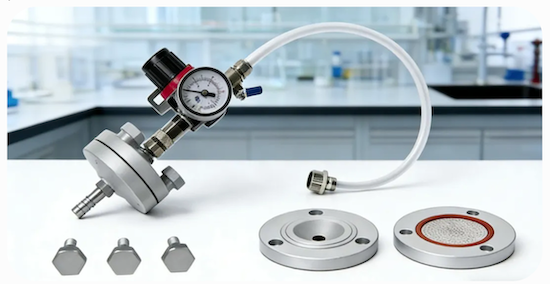
1) Instrument Setup
Install a 0.45 μm membrane in a standard SDI tester with proper sealing.
2) System Flushing
Flush the system for 3–5 minutes to remove residual contaminants and air.
3) Pressure Adjustment
Stabilize pressure at 0.21 MPa and record t₁.
4) Continuous Filtration
Maintain constant pressure for 15 minutes, noting any premature blockage.
5) Second Measurement
Record t₂, or calculate it if 500 mL cannot be collected.
6) Data Validation
Conduct three parallel tests and average the results; relative deviation must be ≤5%.
3. Practical Applications of SDI in RO Systems
In RO systems, SDI is not merely a testing parameter - it is a practical engineering tool that guides pretreatment selection, operational monitoring, and membrane fouling diagnosis.
1) Pretreatment Selection
SDI > 5: Advanced pretreatment required (coagulation + filtration + ultrafiltration)
SDI < 3: Simple pretreatment is sufficient
In a desalination project, adding ultrafiltration reduced SDI from 6.2 to 2.5, extending membrane life from 2 to 3.5 years.
2) Operational Monitoring
SDI increase ≥ 0.5 → pretreatment efficiency declining
SDI spike ≥ 1.0 → possible system failure, immediate inspection required
Early detection prevents irreversible membrane damage.
3) Fouling Diagnosis Support
High SDI + pressure rise → colloidal fouling
Stable SDI + water quality decline → biological fouling or scaling
Integrated analysis enables targeted cleaning strategies and longer membrane service life.
4. Key Considerations for Accurate SDI Measurement
In practice, inaccurate SDI results are usually caused by operational details, not the index itself.
1) Membrane Selection
Always use a 0.45 μm mixed cellulose ester membrane.
Hydrophobic membranes such as PTFE may trap air bubbles and distort filtration rates.
2) Pressure Control
Maintain constant pressure at0.21 MPa, with fluctuations within±0.01 MPa.
Both excessive and insufficient pressure can lead to inaccurate results.
3) Sample Representativeness
Samples should be taken after pretreatment and before the RO system, avoiding dead zones to ensure representative water quality.
4) Membrane Replacement and High-Turbidity Samples
Replace the membrane after each test.
High-turbidity samples should be diluted before testing to prevent rapid clogging.
As the “gold standard” for diagnosing RO feed water quality, the accurate measurement of SDI directly determines the operational stability and economic performance of reverse osmosis systems. For water treatment professionals, mastering standardized SDI testing methods, optimizing pretreatment processes based on source water characteristics, and establishingSDI - based early warning mechanisms are essential to achieving long-term, high-efficiency membrane operation.